Pages

Showing posts with label blog. Show all posts

Friday, June 10, 2011

The Weight of it All


I want to weigh more.  I think I’m on the right road with my current diet. I start out my day healthy: two pieces of whole wheat toast in the morning; low-sugar jelly with no butter; yogurt with a banana or my mid-morning snack, a Lean Cuisine for lunch. Then, I begin compensating for any sleep lost with some sugar. Hopefully I have some chocolate on hand. Towards the end of the day, when my metabolism starts slowing down, I strategically begin eating chips. Cheese makes any meal worth eating, so, sprinkle, sprinkle. A couple of hours before bed I bring out the serious stuff: a chocolate chip cookie or two, or some chocolate-chip banana bread if I have some on hand. Loading the end of the day with calories seems to be working.

No, my BMI chart doesn’t suggest that I should weigh more. Nor does my on-the-edge cholesterol levels or my family history loaded with hypertension and heart disease. It’s basically my daily routine that whispers (some days screams) the suggestion to me. Allow me to illustrate the routine if it isn’t clear to you: Get out of bed, drop the kids off to school – watch stuff fall out of the van at both stops – then head to work. Tour Rapid City between pick-ups and drop-offs for my kids’ activities, go home to the wreckage left from getting ready that morning, then, as my friend Debbie would say, move stuff around the house. Stare at the refrigerator wondering if any still creatures might come to life for dinner, then do dishes, laundry, math games. The final curtain call: tip over into bed. Then, start again the next morning.

I want my life to weigh more. Can this drab, ordinary routine be the context for greatness? For weighty impact on others? Can touring Rapid City change things, touch others’ lives? I know, I know.  I can use this as valuable bonding time with my kids because they are a captive audience, but what if they aren’t speaking to me that day? Or what if the drool running down the side of my mouth is the only fount of spiritual wisdom and guidance that is springing forth that day? Perhaps this points to my lack of exercise, but have you ever wondered what the lives of those that marked our world with magnificence looked like?  Really? Soccer practice, math games, kitty litter? Office jobs, errands, grocery shopping?

Consider what Paul has to say in 2 Thessalonians 1, 11-12: “Because we know that this extraordinary day is just ahead, we pray for you all the time – pray that our God will make you fit for what he’s called you to be, pray that he’ll fill your good ideas and acts of faith with his own energy so that it all amounts to something”.  (2 Thessalonians 1:11-12, The Message)

Notice, there’s a twist. It didn’t say, “Pray that your good ideas and acts of faith will be great enough to amount to something”.  It said, pray that “he’ll fill your good ideas and acts of faith with his own energy so that it all amounts to something”.  Now I don’t really understand what this all means. But doesn’t the text seem to suggest that, without His energy, acts of faith are meaningless? Could it be that the acts he’s referring to are somewhat ordinary in nature?

I have pondered this subject during many a van trip. What if my good ideas aren’t very good? What if my acts of faith are somewhat…faithless? How does all of this add up to something that makes a mark? Really all I can come up with is this: it seems to me that greatness isn’t about doing great things. I’m not even convinced of the maxim,  “Greatness is about doing small things in great ways”. I think, somehow, God makes great out of ordinary things. For some reason, He uses ordinary things as building blocks in His kingdom. Somehow, they have weight.

Consider the English language. Its building blocks are ordinary markings on a page – ink blobs – that mean very little until someone breathes into them. Makes sentences out of them. Puts emotion into them. Uses them to communicate something meaningful.

For some reason, God has chosen ordinary things as the characters in His language. Simply put, He uses ordinary things to get things done. He uses them to talk to people. To show people what He’s up to. Van trips “a”. Peanut butter cleanups “b”. Dishes “c”. Kitty litter “d”. Fixing a printer jam “e”. Complimenting a co-worker on her new blouse “f”. Treating the restaurant waiter nicely “g”. Finishing the sales report at work “h”. Listening to a friend vent about problems “i”. Making a meal for someone laid up from surgery “j”. God breathes into these things, and he makes sentences out of them.  Uses them to communicate something meaningful. He makes them amount to something. Something that has weight.

We know the letters of the alphabet well, but how do we see the sentences behind them? How do we reconcile the discrepancies we see between the drab and the magnificent? Perhaps God doesn’t see the same discrepancies we do. Perhaps it takes faith to believe that the mundane matters. Bucket loads of faith. Way more than I seem to have on hand most days. The text does suggest there is some sort of asking involved- praying that the daily drab will morph into significance. Perhaps asking has the mysterious outcome of adding weight to our lives, but as importantly, producing the ability to see the weight our lives have with His energy at work.

I think it’s time to put away my bag of chips. I guess there are better ways to gain weight.  Besides, I have to run my kids to choir practice.

©2010, Amy Gusso

Holiness


Holiness. The more I get to know God, the more I think differently about what that word means. At one time, it meant a threatening, confining perfection that hangs over my head like a vaulted ceiling I can never reach. The more I learn about the boundless grace of God, the ceiling disappears into thin air. I look above me and all I can see is sky. Stars. I see His glory. He erases the ceiling, so I can begin to see Him for who He really is.  He erases the ceiling, so that I’m not constantly reminded of all that I am not. He erases the ceiling, to show me that He sees me. Intimately. Even when I am enticed by other lovers.  Holiness. The kind of love that is so void of pride, it’s a vacuum. The kind of love that is so absent of self-protection that it pursues me, though I am an adulteress. The absence of pride in this holiness thinks nothing about alluring me again, and again, though I betray Him. That’s holiness.

“Therefore I will block her path with thornbushes;
I will wall her in so that she cannot find her way.
She will chase after her lovers but not catch them;
she will look for them but not find them.
Then she will say,
“I will go back to my husband as at first…”
Therefore I am now going to allure her;
I will lead her into the desert
and speak tenderly to her…
“In that day,” declares the LORD,
“you will call me ‘my husband’;
you will no longer call me ‘my master.’”


(Hos. 2:6-7, 14, 16 NIV)

Lord of the Flies

The ground feels soft. My feet feel heavy. I cannot step away.
The earth begins to open. A patch of murky green grass becomes a patch of black mire.
The mire dissolves into nothingness; black nothingness.
My left foot in the black nothingness; right foot still on ground. I begin to lose my footing.
I feel its gravitational pull. It’s a terrifying pull. I don’t want to go down this time.
I’ve been here before.
It’s the dark cavity of depression, and I start sliding in. Both feet this time.
Sliding,
now falling.
Falling down the black hole.
All I see are mixed shades of gray and black. And the vertical lines of movement as I fall.
The depths of this hole are abysmal; I know I could go further. The sides are narrow; I am claustrophobic.
I gasp from breathing in the thick fog of emptiness.
I extend my arms to reach up. I need a rescue. I feel for the texture of a rope.
I need a lifeline.
But my hands are so slippery. I fear my hands are so slippery that if I were offered one, I wouldn’t be able to grab onto it.
Besides, does anyone even know I am here?
Falling,
falling,
now sounds. Flies. They buzz and hit my skin. They irritate. More of them, more of them. They gather around my hands.
I move my hands and notice they feel sticky. Gluey. Flypaper. Covered with flypaper.
I feel slight warmth in my hands, now slight pressure. Not a rope; a hand.
Now a gentle pull in my arms.  Slow upward movement.
Now tiny glows; luminous specks. And sounds. Not a buzz like before, but a calming whir.
Fireflies flickering. Emitting hope.
©2010, Amy Gusso

Beauty Interrupted

Last weekend I had the unexpected joy of hearing the North Dakota State University Concert Choir sing. They did a joint concert with the Rapid City Children’s Chorus, with whom my daughter sings.  The audience was comprised mostly of parents, grandparents, and younger siblings of the kids in the Children’s Chorus.

The Children’s Chorus opened with an impressive performance.  An intermission followed, during which I scanned the program of the NDSU Choir, finding only a small handful of college choristers on the roster who were not music majors. For this reason, they were bound to be good.

The chorus immediately captured me with their swells of pianissimo to forte; forte to hushed pianissimo. From the “Singet frisch und wohlgemut” to “Here I Am”, the luxuriant sound flowed like a rich caramel macchiato latte. My emotions crested as I was caught up in the memory of singing with the South Dakota State University Concert Choir over 20 years ago. I was hypnotized by the exquisiteness of their music and the hope in the words they were singing. It was ethereal. Except… it didn’t happen quite like that.

All the stuff about the luxuriant sound, the caramel macchiato latte, the exquisiteness of their music – that’s all true. But the cresting of my emotions did not happen in the form of a smooth, glorious rise, as in the rise of a wave, followed by sprays of water that reflect the noon-day sunlight. Instead, the waves were choppy, thrust by wind gusts. In reality, it went a bit like this:

A capella, vittorioso, Key of D: “Children sing all together, Praise the God of heaven, our need He has recognized, (kid #1 whines)  and his dear Son sent from above, that we might praise Him (kid #1 screams, heads start to turn) here on earth. Praise we with love (grandpa #1 coughs loudly) and thanks (father 1 leaves the theatre, door slams behind him). Sing a new song to the Lord (kid #1 screams again, more heads turn). Praise him (kid #2 joins in) from the bottom of our hearts (kid #3 drops his toy truck on the cement floor), with one accord, and hope freely that to him (mother #1 whispers loudly telling kid #1 to be quiet) our service might be (kid #2’s screams turns into a wailing cry) a pleasure.”
For the love of SAM and all things good, if I was going to have any hope of experiencing an emotional high in the next hour, I needed to take action, quickly. I had three basic choices, as I saw it. One: Strangle kid #1.  Two: Strangle mother #1.  Three: Strangle both, in addition to kid #2. While mulling over my choices, it became apparent that all three might be a bit un-lady-like. The situation probably called for a more respectable course of action. So I left my seat and found one up close, hoping to hear better. Little did I know I sat down right behind kid #3, whose was chewing on loud snacks and moving from seat-to-seat, dropping markers.

Doesn’t it seem like that’s how beauty is in our lives? It comes, and then, it is interrupted. It washes over us, and then it’s gone. Beautiful sounds are interrupted by screaming kids. The concert of your favorite artist takes you to another place beyond this world, and for two consecutive hours you believe everything really is glorious. Then, you gather your belongings, make your way out to the parking lot with swarms of people, and fight traffic to get home. A vacation to the ocean is full of relaxation, warm sun, and beauty as far as the eye can see, and then, it comes to an end. It’s back to work.  A beautiful experience that begins to fulfill a life-long dream is cut off. Beauty is interrupted by disappointment; disillusionment. A beautiful relationship is cut short by change. People move away. A treasured relationship can be interrupted; damaged by anger, by disease, and ultimately, by death.

Where do we file regrets? The ache from a rhapsody that rises, then comes to a halt? Broken relationships? Dashed dreams? They don’t fit on 8 ½ x 11 sheets of paper, and therefore, we can’t just store them in a filing cabinet, away from plain view, with labels like “ Regret”. “Friend that moved away”. “Disappointment #1”, “Grandmother that has Alzheimer’s”. They have odd shapes. They are jagged, sometimes caked with mud. They don’t fit anywhere. Each interrupted, broken piece of beauty is like a broken piece of colored glass with rough edges. We feel pain as the glass breaks, and then we ache over our inability to mend them; resolve them, to resume the songs they represent. Since we can’t fix them, and we can’t file them, we often throw them in the trash so that, finally, we can put an end to staring at their brokenness.

But we are not so clever.  Even as we think they are being safely whisked away, to the junkyard, forever out of site, God snatches them in secret. He keeps them. Protects them.  Watches over them. You see, He is the master stained-glass craftsman.  One day, we will be His apprentices, learning the craft of stained glass creation and restoration. He will retrieve these pieces from safekeeping and hand them over to us so that we can begin building. In their disjointedness and jaggedness they are the perfect shape to create a window that will display an amalgamation of the broken, unfinished pieces of our lives.  We won’t have to force the glass pieces to fit together. They will eerily interlock to form an unexpected, breathtaking beauty. That regret will fit perfectly with that disappointment; that loss with that heartache.  Using putty and solder, we’ll work right alongside our loved ones, perhaps helping one another; turn our broken pieces into beautiful works of art. At last, we will get to see, in visible form, their interwoven purposes.  It will be the ultimate display of God’s ability to turn brokenness to beauty. Beauty, interrupted. Beauty, restored. Rhapsody resumed.

Epilogue
In a week we celebrate Easter. It’s the ultimate reality of beauty broken, beauty restored. The beautiful life of Jesus, cut short. Broken. Jagged. The disciples didn’t know where to file this reality. It wouldn’t fit anywhere that made sense; nowhere that would alleviate their devastation. But God, using the same power that restores our brokenness, restored Jesus’ brokenness. This restoration is now what restores us. The new resurrection reality doesn’t fit nicely in a filing cabinet either. It isn’t well-stored. It’s well-lived.  Have a blessed Easter.

“May God, who puts all things together,
makes all things whole,
Who made a lasting mark through the sacrifice of Jesus,
the sacrifice of blood that sealed the eternal covenant,
Who led Jesus, our Great Shepherd,
up and alive from the dead,
Now put you together, provide you
with everything you need to please him,
Make us into what gives him most pleasure,
by means of the sacrifice of Jesus, the Messiah.
All glory to Jesus forever and always!
Oh yes, yes, yes. (Hebrews 13:20-:21, the Message)

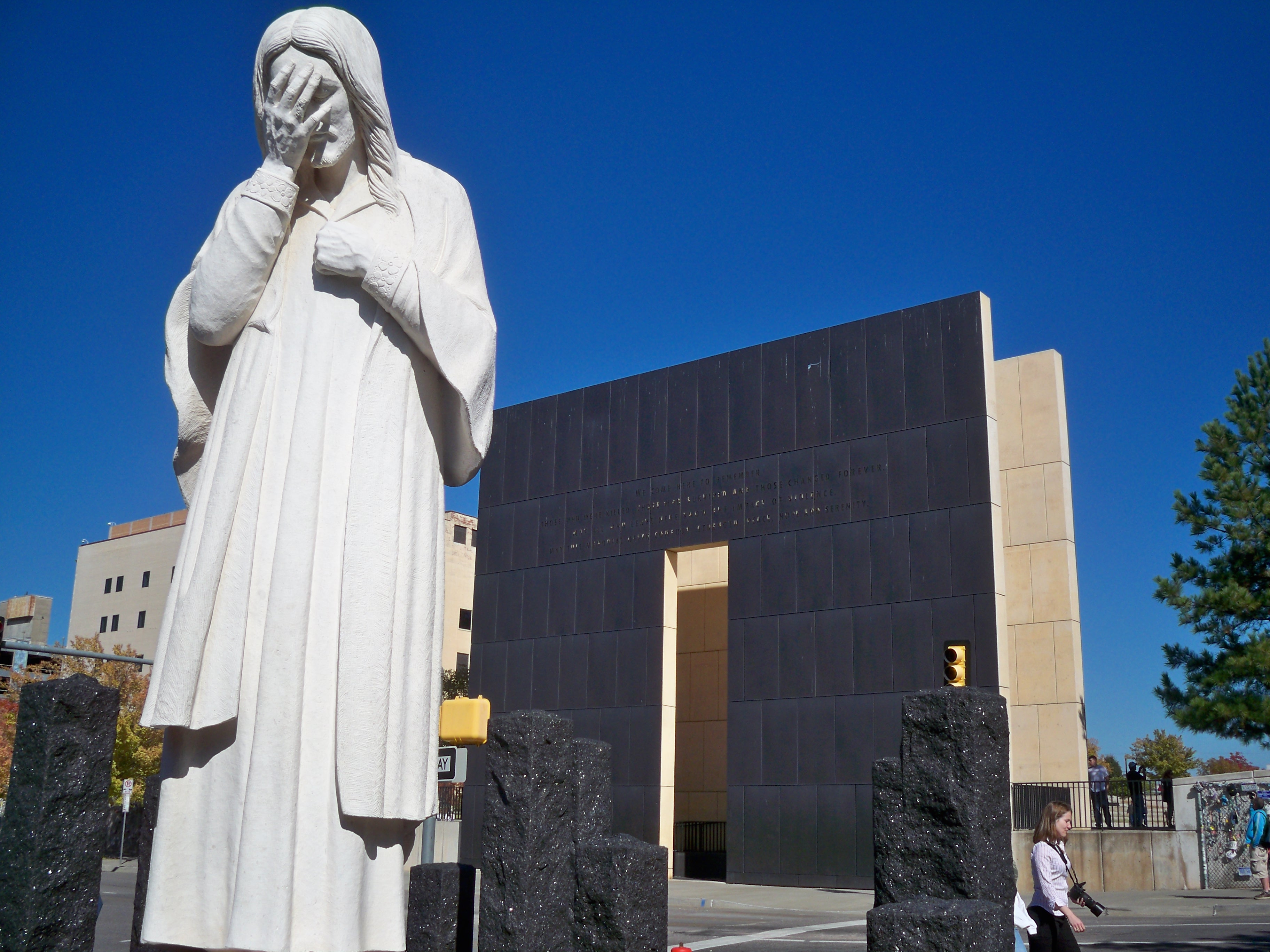
Jesus Wept (Oklahoma City Tragedy)


Today, April 19th, marks the 15th anniversary of the tragic bombing of the Alfred P. Murrah Federal Building. Last fall, my husband and I visited the Oklahoma City National Memorial (we had flown to Oklahoma City to see a U2 concert in celebration of my 40th birthday). Neither one of us were prepared for the poignancy of that experience.

The memorial stands where the federal building once stood, and encompasses the surrounding area that was ravaged by the attack. Our first trip there was at night, and our eyes were first captured by the illuminated “9:01” engraved in the concrete entrance gate. Beyond the gate, on the left, we heard the sounds of gently flowing water. A pool serenely spans the length of the opening gate and the end gate, which is illuminated “9:03”. The water bridges the heart-wrenching chasm between the innocence of 9:01 and the terror of 9:03. Its tranquility competed with sharper emotions I felt, evoked by images my mind could not set aside – images of rubble, cries, blood, brokenness, and grief that once stood here.

On the right, an eerily lit field of 168 chairs speaks unceasingly of the lives lost that day. Nineteen of these chairs were smaller than the rest. Their voices spoke with softer, higher tones. Children. We left that night solemn, contemplative, impacted.

In the morning, we came back in the daylight, and could better see the fence that guards the edge of the memorial, running parallel to the busy downtown street. It was originally installed to protect the site, and for years collected mementos of mourners. Now, the nearby museum holds most of these tokens in safekeeping, but the fence is still full of items left from recent visitors. These mementos hold various shapes and colors; wreaths, shirts, jewelry, hats, pictures, poems; all communicating the kaleidoscope of human emotions that surround the devastation, even today, fifteen years later. We left our memento in the adjacent children’s area, with chalk, on a chalkboard, next to other expressions of love and grief, “With love, from the Gussos”.

We left the entrance gate, walked across the street, and came upon the site that affected me the most. It was a statue of Jesus; head bowed down with His hand over His face. The stone beneath was engraved with three words: “And Jesus Wept”. As we studied the site it became apparent this was not part of the official memorial; rather, a display on the grounds where the parish house of St. Joseph’s Catholic Church stood prior to the blast. I am grateful that someone anticipated my deep need for this final piece of communication.

You see, the memorial beautifully displays how ashes can morph into beauty, how love transcends all tragedy, and how hope cannot be destroyed by evil. We have been assured that God can make good out of painful circumstances; and that pain finds profound purpose in Him. But we still need to know that He weeps. That His nerves connect with ours, and feel our stabbing pain. That pain is not His wish. Death was not of His design. Just as He rose Lazarus from the dead; and it accomplished great purpose because many were saved because of this miracle that bore witness to His nature, He was still deeply moved by Mary’s sorrow. So, He wept. Two words, one verse; so simply, so strongly states what we need to know. “Jesus wept. (John 11:35 , NASB)”

View pictures of the “And Jesus Wept” memorial at:
http://dcmemorials.com/index_indiv0004101.htm
Official site of the Oklahoma City National Memorial:
http://www.oklahomacitynationalmemorial.org/
 

13th Chair


Tears, tears, more tears. “Mom, I got stupid 13th chair!” My daughter received the news two days after her audition for chair placement for the annual “Strings in Concert”, featuring Rapid City’s 4th- 8th grade orchestra students. The chasm between her expectation of herself and reality was too big for her to cross.

Megan’s biological blood type is AB, but her personality blood type is 100% type A. She makes high demands of herself. If her straight-A report card is corrupted by a “B” cell, she quickly diagnoses the entire report card as malignant. “B” cannot stand on its own, nor be self-contained, it spreads and infects all of the “A’s.” Just as important to her is class rank. If she’s not towering over her seventh-grade core, she might as well be at the bottom. Though Megan has never had a private violin lesson in her entire life, she is accustomed to consistently holding one of the top three chairs in her school orchestra. You see, she must be at the top. Her sense of self-worth depends on it.

When Megan was in fourth grade, I initiated an email exchange with my mother. “Will you pray for little Meggie and us? She is so tired and stressed out. She got a “basic” rating in math yesterday, and that just won’t do. She has to be the best at everything and it’s wearing her out….we just need wisdom on how to handle such a strange breed that must perform well and be perfect at absolutely everything…..” My mom responded, “Of course I will……what you are describing to me is YOU (when you were young) and WE were the ones looking for direction with just as much concern as you have”.

Ouch. Yes, I guess this “strange breed” was actually birthed by me. My contribution to Megan’s blood type “AB” is the A. For four years in high school I clawed my way through pages and pages of books to be valedictorian. I had to. My failure to do so would have rendered me incompetent, worthless. I vied all four years of high school for vocal solo parts, chair placement in band, casting of school musical parts, and burned my finger prints into my piano repeating songs endlessly in pursuit of a “1” score at music contest.

Why this dual-generational need to jockey for position? Why the drive to achieve? Why the striving to be perfect? It wasn’t until I was in my 30s that I realized these were even questions to be asked. That was also the time it became evident what years of grasping for first place had done to me.

Reeling the tape backward to 7th grade (Megan’s age) for me conjures up emotions of feeling awkward, inadequate, and sometimes, rejected. Like everyone else, I was born with a need to “get life” – to feel valuable, accepted. And I, like everyone else, will do whatever it takes to get it. By the first year of high school, I discovered a strategy that seemed to hold promise: Be perfect. Be the best at the things I showed aptitude for. For me, this was in academics and music.

This strategy actually worked well for quite some time. Hours of vocalizing propped me up to win pageant titles. My straight-A report card earned me multiple scholarships, and better yet, dinners with applause and my name in newspapers. I could add these to my title as President of the Honor Society, plus the seat I held in Student Senate in college to my first resume which landed me a job that made others jealous by the time I was a sophomore in college. All these things seemed to seal the value I had hoped I was creating; the liquid metal now set into a trophy I would carry with me into a lifetime of achievement. In my adult years, class rank and contest scores morphed into job performance and church involvement. A student’s reflection is seen in report cards; an adult’s, in resumes, certificates, positions. I have said “yes” to countless things because I didn’t feel I had any other choice, that is, if I wanted to get life. So, one “yes” led to another, and yet to another, and before I knew it, my life was the spin-cycle of my own strategy; a cycle of need, then grasping, then affirming the need, then starting all over again.

Of course, the execution of any strategy requires a power source and control over its tactics. As long as one has both, success is within reach. Ten years ago, this control began to slip from my hands. My power supply began to get cut off, one cord at a time. Severe insomnia, leaving me often in a zombie-like state, pulled the first plug. I barreled my way through it, determined that it would not interfere with all of the things I had said “yes” to. It became a little harder to keep this up when TMJ entered the picture. This was my first taste of chronic pain. Three years later, even now; chronic neck pain. My “yes” activities slowly became replaced with doctor’s appointments, chiropractors, physical therapists, medication follow-ups, injections, denervation procedures, and hundreds of hours of home therapy. All of this amounted to ten years of thwarted strategy. Ten years of grappling with my inability to get life in the only way I knew how. Ten years of watching my Tower of Babel fall, crumble, scatter.

This decade-long journey took me through various deserts of depression. I eventually found a spot next to an oasis and built a hut of acceptance. It’s not completely furnished yet, but I’m settled there. I don’t feel near the need to grasp anymore. I’m not compelled to say “yes”. God has slowly transformed my perception of internal value. I certainly will always have this tendency towards the wild animal of my old strategy, but it has been tamed through the bridle of pain. I’m learning to decipher between excellence, and its evil twin, perfectionism. Excellence seems to want the best from the resources God has provided at the present time. It tends to think people should come first. Perfectionism, on the other hand, wears a fig leaf to mask its true identity. It’s a smooth criminal. You roll out the red carpet so that it can slink through your front door like a model in Vogue. Then, it steals what you value the most – your energy, your joy, even your relationships. It rips you off. And others around you too.

This fall I had a conference with one of Megan’s teachers, Mrs. Gill. I realized I hadn’t come to this conference for Megan, but for me. I was beaming (and blushing) as she went on to tell me how courteous, helpful, and respectful Megan is to others; and that she exhibits strong leadership in her core. We then proceeded to discuss her grade in Science class. Mrs. Gill updated me on what her current grade was; I think a 97, and then proceeded to give me her perspective, which was very poignant. She told me about the extra credit that Megan could take advantage of to get that grade up to a 100%, but that she actually really admires the fact that she isn’t always driven to do it. “It’s a sense of wholeness of person,” she said. I went on to tell her about my performance mentality in school, and my attempts to encourage Megan to take a different path. She welled up with tears and offered up her encouragement. “Amy, you are breaking this pattern for the next generation,” she said. I was stunned. I walked away with the sense that God had lifted the veil to see that one of my greatest “achievements” in life will be the achievement of teaching my daughter that she doesn’t have to achieve. That life isn’t a contest. To do things because you enjoy them, not to win. You don’t have to be the best. The 13th chair isn’t any bigger than the chair in 1st place. It can hold just as much joy. What a strange thought from such a strange breed.

The Morning After I Retire

I wrote this for my mother, who retired on Thursday. Congratulations; you deserve every cup of Bailey’s you can get your hands on.

The Morning After I Retire

The morning after I retire, I’m going to make my coffee stout – no need to drink half-caff to counteract the 10:00 am spiked blood pressure I normally experience at the office.

I’m going to sit on my couch and imagine the hum at the office: the Fed Ex man making deliveries, the phone ringing, the shredder running,  the sound of the door slamming as people come through, and the spirited cackles of my co-workers.

I’m going to gaze at the tree in my back yard: the one I’ve never noticed before.  I’ll fix my eyes on its auburn coloring, the two dead branches that stick up at a 45-degree angle, and the squirrel that dances on the high green needles. Then I’ll notice the empty space above my sliding glass doors that could really use a wrought-iron sconce-type-thing to liven it up.

I’ll notice my neighbors who walk at 9:00: a young mother with teeny moving being covered with a pretty hat in a stroller; a retired couple-the man, nodding; the woman, waving her arms in cadence as she talks. I’ll wonder what they are chatting about; it wouldn’t be about their jobs. Maybe, about their grandchildren? Their next trip? At this point, it’s hard for me to imagine what else would occupy one’s mind. Then I’ll catch a clean view of Mrs. Paxton run by in her spandex shorts, headphones on, ponytail bouncing-the skinny devil. Is this what non-working women have been doing over the last 40 years?

I’ll probably sip my coffee, breathe deeply, and ask “What now?”  I might imagine a scene in which I introduce myself to the new me that I’ve never met – the one who doesn’t know anything different than office life.  What will be my first impression of this new me? Will she strike me as one who has just found gold? Or will she seem lost, floundering?

I think I’ll imagine my best day at work; the one where I got to see the results of my best effort and my strengths acting in concert ; and I’ll once again revel in the magic of that day – the day when I put a dent in something; made a mark. Then I’ll imagine my worst day; where all of the motley dysfunctions seemed to collide and unexpectedly blew up in my face like a land mine. On that day, I was unfairly criticized; overwhelmed, and disillusioned – I mistakenly thought my job was more satisfying than this. I remember feeling trapped with the same annoying situations to face every day, and no better options.

It will dawn on me that best day, the worst day, and the ordinary days crystallized on the day I retired.  I’ll pick up the necklace that was given to me yesterday at my retirement party and look closely at the stones in the pendant. As I stare at them, I begin to see imbedded images. One is yellow; in it I see the encouragement I was able to offer a co-worker when her son was in juvenile services, and she was anticipating the looming court date that would settle his fate for the next two years. One is green – it resembles the lives of those my work impacted completely unbeknownst to me. I see their families standing in the background; their lives also affected by the fact that I was faithful to get out of bed morning after morning to the sound of my alarm, and offer the best my tired mind could give. One is iridescent; it sparkles. At first I have a hard time making it out, but then, I see, it’s my character. It has been changed by the things I hated most about work – the co-worker who always felt free to criticize my work, the new meaningless rules and regulations that constantly demanded my compliance, the things that would not change despite my best lobbying efforts.

My deep thoughts will be interrupted by a phone call from a friend asking me out for lunch. I’ll do the usual scanning of my calendar in my head; searching for a date that is beyond the deadline I usually face on the 15th of every month. I’ll suddenly remember that someone else will now handle that deadline, and, now I’ll find it impossible to find a reason that I couldn’t go. I’ll suggest dinner, instead, in order to avoid the discomfort of making plans on such short notice.

I’ll reach for a pad of paper and a pencil and sit down again. I write at the top: Things I’ve Always Wanted to Do but Never Had the Time.  What will first come to mind are those that gnawed at me when my kids were growing up; those things I could have done if I would have had my summers off like my teacher friends did: organizing 20-year-old photos thrown in a box, cataloging video collections spanning 30 years on old mini-DV tapes. These make the top of my list. As I continue thinking, I’ll feel a twinge in my stomach when I think of how Gwyneth Johnston – the lady in my church council – made me madder than a hornet,  and how I have done nothing besides let the anger fester for the past 10 years. Maybe, then, I’ll decide I should write her a letter. Then I’ll think of my good friend who moved away 30 years ago, and ponder what it would be like if I bought a plane ticket and surprised her by my arrival.

I’ll see the postman go by, and discover that he comes by at 10:45 am. I’ll set my coffee down and run out to the mailbox. In my stack of mail I’ll see an envelope from Dakota Choral Union, and remember I filled out a card at my granddaughter’s choir concert a few ago expressing my interest in being a part of the choir. This Christmas they are performing select pieces from “The Messiah”. I see rehearsals are on Mondays and Thursdays from 7-9 pm. My first thought:  I usually prepare for Tuesday morning staff meetings Monday evenings; but, oh, yes – no more staff meetings. This might actually work.  I’ll wonder what people wear to music rehearsals. Maybe I should buy some new lipstick. The next envelope in the stack is from Modrick’s Travel: “Cruise packages starting at $1599”.  As I walk back to the house I realize that I need to actually name the places I’ve always wanted to visit; realizing I have lumped them into a generic  place called “Oh, the Places I’ll Go When I Retire”.  I’ll pick up my coffee, sit back down, and add these to the list. Finally, I’ll add: “Figure out what else I’ve always wanted to do but never had the time”.

I think I might wonder how one changes gears so abruptly – from one life to another in one day. I’ll wonder what my mom felt when she retired twenty years ago. What did she do that morning? What did she feel? What did she see in her gems? What was on her list? And I’ll realize that what I actually did on the morning after the day I retired was completely different than what I thought I would do.  I’ll find it more confusing, more joyful, more reflective, and more uneventful than I expected. That’s when I’ll get up from my chair, and add a little Bailey’s Irish cream to my coffee, because I can.  And I’ll put my tennis shoes on, go out my front door, start walking, and ponder what I’ll do on the morning of the second day of my retirement.

Light of Night

Last night while huddled in bed I began to hear the trickle of rain. I looked out my window; since it was early in the evening, the walls of the world had not yet turned black; they were gray. Small puffs of mist danced eerily on the road, and a patch of fog hovered over the mountain pass as if someone had dropped a piece of batting that got caught on the tips of the pine trees. The air sagged from water. Inanimate objects such as my mailbox that were being drenched in rain seemed to say “go back to bed where it’s safe”.  The muted setting elicited the same feelings that a mystery flick evokes: fear, dread, sadness, hopelessness.

Today is the perfect day. The sun showers light, as evidenced by the diagonal shadows cast on the tree trunks. The spring birds twitter to one another, the hawks caw, the green leaves flutter in the soft breeze; and butterflies lift and descend quickly, as if so elated by the new climate that they have lost all sense of direction.  Purple flowers peek through the water-logged soil and the foliage surrounding them is vividly green, almost as if it were computer-generated.

Yesterday’s backdrop was clouds, which foreshadowed the evening rain; today, it’s sunlight and warmth. Yesterday, I was brooding about things that won’t change and was terrified of the future. Today, feelings of confidence and hope return. Circumstances rarely change overnight; why the drastic difference in one’s outlook in less than twenty-four hours? Light.

Researchers show that we have an improved mood and a greater propensity to take risks in sun-lit weather. Something in us is drawn to illumination. To be in the dark scares us; makes us feel uneasy. In blackness, problems seem larger than life. In the light, they lose their ferocity. We were created to crave light. Perhaps this is why God calls Himself the Light. He knows we need it to have hope and to dispel our fears.

In Psalm 139, David speaks about God’s ubiquity; of the magnitude and reach of His presence.

In verses 11 & 12 he talks specifically about God’s nearness in the dark.
“Then I say to myself, “Oh, he even sees me in the dark!
At night I’m immersed in the light!”
It’s a fact: darkness isn’t dark to you;
Night and day, darkness and light, they’re all the same to you.”
Psalm 139:1-12 (The Message)

God says that night and day are the same to Him. Did you hear this? Night and day are the same to Him. In the night – in the dark -He’s immersed in the light.

I think this truth is loaded with meaning and offers us more solace than we often realize. In Psalm 139, David opens in verse 1 by asking God to “investigate” Him, and continues to tell us, by letting us peek in on his prayer,  about His intimate knowledge of us and His nearness to us at all times and in all places; even in darkness. Certainly this means that we cannot hide from Him. The fact that we cannot, in a weak moment, choose to take off on a plane to an island far away from the One who loves us the most is really quite a comfort.  But could this fact – that darkness and light are no different to Him – also tell us something about His vantage point; the way He sees things? I think it does.

A giant problem you or I face makes us feel like we are walking in the dark – for days, week, or even years. But to God, that same situation is staged in sunlight. To Him, it’s a 75 degree day. The birds are chirping and flowers are diffusing their fragrance; He is full of confidence. To Him, it is not dark, because He illuminates. Imagine how that giant problem would seem if brilliant sunlight were cast on it; if it were in the context of a hopeful spring day. Not quite as overwhelming. This is the true nature of all of our problems with His luminescence. They are much smaller than they seem; minimized by the ambience of yellow light and blossoming. The added comfort we are being offered in David’s words is this:  We are being cared by the One who is with us as much in our darkness as in our light. And He doesn’t lose heart in the dark like we do. His vision of our lives – even with their messes, problems, failures, and inadequacies- isn’t skewed by gray skies; He sees them crystal-clearly, as they really are – lives filled with hope and with chances (that we call problems) for Him to show us what He can do with all of the power and resources of the world at his disposal.

The forecast for tomorrow warns of winds and rain – that is, for me. To God, it looks like it’s going to be another gorgeous day – mid-70’s, blue sky, gentle breeze.  When I huddle in bed listening to the sound of rain, I’ll imagine what the world must look like from the vantage point of the Light of the Night.